
Mission Fields In Shan States
Missionaries started their missions by opening mission fields in various places in the Shan States. They stationed at the mission fields and did the missionary works among the Shan through medical services, educations and evangelistic works. Missionaries to the Shan had established four mission fields in Shan States and one in Kachin State.
The First Mission Field, HsiPaw (1890)
HsiPaw was one of the capitals of the Northern principality of the Shan States under SaoPha’s control. Rev. Cushing first visited HsiPaw in the year 1868. Cushing reported on January 1, 1887, that it was impossible to visit any of the Shan principalities on account of the unsettled relations of all the princes to the English Government, so that Cushing and Mr. Calder had to stay in Mandalay.
Toward the close of the month, the HsiPaw SaoPha, who had been helped by Dr. Cushing when he had difficulties with the British government in Rangoon, arrived in Mandalay. He recognized Cushing by acquaintance of former years, and he very cordially gave repeated invitations to Cushing to come and live in HsiPaw. He also offered some of his children as his pupils if I would establish a school there. Thus early in 1890, Cushing escorted Dr. and Mrs. M. B. Kirkpatrick to HsiPaw and opened a new station.
Dr. and Mrs. Leeds arrived in HsiPaw on Saturday, March 26, 1890. That was the first mission station to be established in the Shan country. Hospital and school were later opened. SaoPha of HsiPaw donated land and money for the missions. The hospital also received some financial support from government.
Hospital preaching, Bible training, Sunday school, bazaar preaching, jail meeting, and distributing gospel tracts were their main ministries conducted by missionaries.
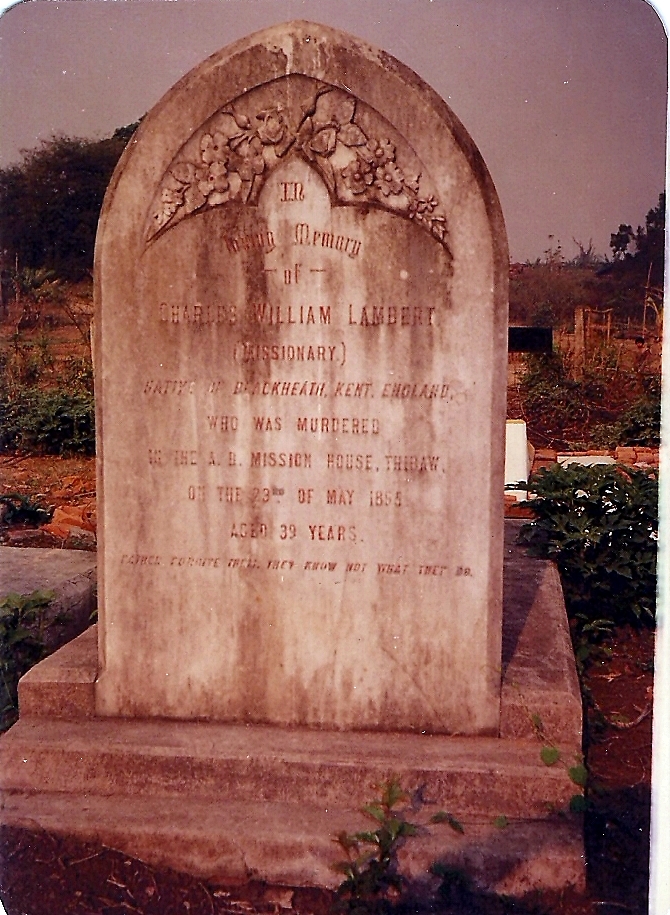
Mr. W.C. Lambert was the first missionary to be murdered in HsiPaw by a thief on May 23, 1895, early morning. He was a dedicated schoolteacher.
Dr. Kirkpatrick, although suffering from a sickness, which he knew it would take his life, persisted in working in HsiPaw as long as he could. Rev. Dr. M. B. Kirkpatrick, M.D. died on February 10, 1915 and was buried in the Christian cemetery in HsiPaw.
Medical work
SaoPha, as a chief and head of the community, knew the importance of health care for the people. He supported missionaries in their medical work by giving them land, money, and helping them build the hospital. In financial support, since the mission board could not give all, SaoPha gave rupees 500, the British Chief Commissioner gave rupees 500, and rupees 500 were received from the government because the hospital had also cared for many government employees. SaoPha had given the logs and about twenty men sawing lumber and twenty carpenters at work on the frame and the coolies had the postholes all dug. The patients came from many villages nearby, and some had come from very distant places. SaoPha and other members of their families were among the patients.
Dr. Leeds reported in 1904 that the population in HsiPaw was 4,000. The average mortality rate was 65%. They made two extensive tours in January and February and preached the gospel to the Shan people. Preachers had regular meetings at appointed times and places to preach the gospel to the public. There were 3 baptized, 2 restored, 2 deaths, 2 exclusions, and 52 students enrolled at school in a year. The system of bribery was so inwrought into the nature of the people that they did not look upon it as wrongdoing. A total of 1,346 out-patients, 20 in-patients, 165 visits, and 15 operations under chloroform were performed. Receipts are rupees 334 in a year. A new brick hospital was built in 1903, costing 4,500, which was raised locally.
School
It was reported in 1895 by Dr. Kirkpatrick, “There are forty-two pupils enrolled, thirteen from Christian families and twenty-nine from heathen families. We have the joy of seeing those who come regularly taking a real interest in Bible study. After being a few months in school, they ask for a New Testament to take home with them, and then we feel hopeful for the next thing, would is the question What must I do to be saved? I have baptized eight from the school, the last one being our eldest son.”
In 1904 the school had the highest enrolment of fifty-two, three teachers and five classes. Two schoolboys were baptized. An Anglo-vernacular Buddhist school with three teachers was opened in HsiPaw due to the efforts of the Society for the Propagation of Buddhism in Burma.
Evangelistic works
Dr. Kirkpatrick reported in 1893, “There were 306 gospel meetings and 4,791 people attended. There were interesting services in the jail every day at the request of the SaoPha. The attendance and interest were steadily increasing at the bazaar meetings at BweGyo, the outstation. In April, two parties started from Hsipaw on evangelistic tours.
One party, consisting of our best evangelist and two of the oldest and most zealous Christian boys, went towards the south. They stopped several days at YatSauk where they were well received. One day they went to the palace and had a very interesting service. The SaoPha seemed much interested. From there they went to MuongNai via NyaunGywe, MuongSawk, TaungGyi, HoPong and NaungPawn. They were gone for nearly two months and preached in nearly sixty large towns and bazaars.
The second party often started at daybreak, going to a village for breakfast and two or three hours of preaching the gospel and practicing medicine. At most places, they had not heard of the Christian religion, but they were anxious to get English medicines. Then we would go on to another village to spend the night. Our first night was spent at DahDay, a large Shan town. The headman came with a present of fruit and firewood and called the people to the zayat for the evening service. The large zayat was full, and many stood outside where they could hear. Doubtless, many came from curiosity, but some became deeply interested, for they stayed till nearly midnight listening and asking questions, and some had come to HsiPaw for tracts and to ask more questions. This experience was repeated nearly every day. It took us about five hours to climb up the steep mountain path, and as it was very warm and there was no water on the way, we were weary and thirsty. I shall never forget how the headman came out to meet me at the entrance of the village, and his followers brought me water in a large silver cup and a bunch of plantains. Each one of our party, as they came up to the entrance, was given water and fruit.”
“Soon, a great crowd gathered at the zayat, our evangelists spent all of the afternoon and well on into midnight preaching to the people. The Palong did not have a written language. All who could read read Shan. Most of the men and some of the women spoke Shan. They spent several days at NamKham. One day, they had preaching in the big bazaar, Sunday morning had a service for Christians at Brother Cochrane’s new house, when several people who had professed conversion related their experience. They were gone a little more than a month, preached at about thirty villages besides stopping over at NamKham and the two capital cities, NamSan and HsenWi.”
Rev. W.M. Young arrived at HsiPaw in May 1895, five days after Lambert’s death. He baptized two converts in October 1895 and three from the school in January 1896. Two others in the school have requested baptism, and several outsiders are asking for baptism. The general interest seemed to be growing; the attendance at the bazaar meeting was lighter than usual, but the house-to-house work continued about the same, and the outlook for schoolwork was much brighter. The preachers had regularly, at appointed intervals, held meetings in the five places where they had public preaching. Also, in the surrounding villages, regular preaching visits had been made. In the town, visitation was also carried on. At the funerals of acquaintances was a good opportunity to preach whenever possible.
In 1904, there were three baptized, two restored, two deaths, and two exclusions from the Church.
- Bazaar meeting
Kirkpatrick reported in 1895, “We have kept up the bazaar meetings at both BawGyo and the HsiPaw bazaars. At each place we have had good zayats, which are well filled all day on bazaar days. These people come in from all of the surrounding villages, and in this way, a knowledge of the Christian religion is being spread all over this part of the country. At these meetings, many tracts and books, and portions of scripture are sold and given away, and we often have people coming back after many months to ask us questions and to get more books.” - Jail meeting
By request of SaoPha, jail meeting held every day except Sunday. For one hour the prisoners were called together from their work and listen to the gospel message. Several professed conversion and all seem to appreciate our kindness in looking after them. - Bible class
During the rainy season, travel was very difficult. The missionaries did not waste time and organized Bible classes. Preachers, teachers, Bible women, and others had regularly attended with full interest. The average attendance was thirteen.
Church
Rev. Cochrane reported that in 1899, there was 1 Church, 42 members, and 2 added by baptism in HsiPaw. The native Church at HsiPaw raised its pastor’s salary (forty-five rupees per month) in full during the year and had a good balance over.
In 1911 Miss. Slater had been caring for the work during the absence of Rev. Cochrane on furlough. She reported four baptisms and a Church of 65 members.
Mrs. Kirkpatrick had written and translated hymns and had a tract printed. One man who had been a Christian for many years, worked as an assistant preacher, never owned a New Testament until he came to HsiPaw. Sunday services were well attended, and the people were learning how to give for the work of the Church. Since the Church was organized about nine months the collections had amounted to rupees 200. Almost every member gave at least one-tenth of their income, and some even gave more.
Dr. & Mrs. Kirkpatrick were the only Europeans in the city.
Regretfully, today, there is no Shan Church in Hsipaw. Hospital and school were also taken over by government. HsiPaw mission field closed in 1922.
Getting SaoPha’s support
Dr. Kirkpatrick reported, “The SaoPha continues to be very kind and helpful. He gives land, money for medical and schoolwork, all the logs for the chapel, and assists us in every way he can.
On Christmas day, we had a double wedding in the chapel and gave the SaoPha and some of his ministers an invitation. They all came and seemed much interested and impressed by the wedding ceremony. Before leaving the chapel, the SaoPha gave each of the grooms a large silver betel-nut box, and to each of the brides he gave a ruby and diamond ring. To each child in the school, he gave rupees 3, and to me, he gave a bag of rupees 200 for mission work. I doubt if any other station of our society has ever had so much help from the native ruler as we have had here. We do not forget that it is the living God who giveth us richly all things to enjoy.”
Kirkpatrick reported in 1895, “I was going to HsenWi to see SaoPha, and I felt sure if Brother Cochrane would go with us so that he could get from SaoPha the land he needed for school and chapel in NamKham. He finally decided to go with us. Mrs. Cochrane bravely offered to stay with the few natives for ten days in NamKham when he would be gone. It was a great sacrifice on her part, willingly given for Jesus’ sake. We were four days on the road, and at every stopping place we had a good number of listeners and patients.”
“Last year, I was able to do something for SaoPha, which he had not forgotten. He came to see us as soon as we arrived and was very cordial and attentive all the time we were in his city. He was pleased to hear that a mission was being started at NamKham and readily gave Brother Cochrane an order for as much unoccupied land as he wanted for mission use. At the same time, he wanted to know when we could come to his city to begin mission work. He asked us to look over the whole city and select the most desirable site for a mission compound, and he would have it marked and reserved for us. We gladly accepted his offer and selected a fine knoll, which will be near the new palace. From this knoll, one could see all over the city. I counted twenty-three villages in sight. This is a very important field about midway between HsiPaw and NamKham and ought to be occupied at once, while the SaoPha is so friendly and ready to help. At both NamKham and HsenWi, timber is very scarce and poor. Only jungle wood and probably all permanent buildings at both places must be made of brick. We spent one bazaar day here in HsenWi and had crowds of listeners till the rain came on. The SaoPha invited us to the palace for one service. The large room was crowded, and great interest was manifested by some.” NamKham was then under HsenWi SaoPha’s control.
Medical work there was closed down for nine years when Dr. Leeds left, and the station was closed completely in 1916.