
Baptist Missions to the Shan
In 1853, Rev. Moses Homan Bixby was appointed by the American Baptist Missionary Union as a missionary to Burma. He was married to Miss. Susan Dow on November 7, 1849. After a brief service of three years in Moulmain, Burma, he was compelled to return to America because of the failing health of his wife. Susan Dow did not long survive after she arrived in America.
Bixby was again selected on the first Sunday of December 1860 as a missionary to the Shan and sent to Burma again. He left for Burma, taking with him as his new companion and helper Miss. Laura A. Gage, who was the principal of the New Hampton Ladies’ Seminary. They arrived in Rangoon on March 23, 1861. Rangoon was not Shan State but the capital city of Burma. He planned to bring good news of salvation to the Shan people. As it was not possible at that time to enter Shanland, Bixby settled at Toungoo.
Shan Mission in Toungoo

When Bixby arrived in Rangoon, many Shan came from Shan country and took refuge at Toungoo because of the Burman King’s pressure. Bixby reported on March 29, 1861, from Rangoon, “Almost immediately on our arrival, it was announced to me that the Shan were coming over into the British possessions by thousands. We learn from Toungoo that, on account of some warlike disturbance in the Shan country, ten thousand people have come down to the vicinity of Toungoo and that the Commissioner has encouraged them to settle there by furnishing them land. Should they do so, what a field of labor will at once be opened to me! What does this mean? May we not think that God has sent them to meet us by the way? And does it not indicate that we have been moved to commence the Shan Mission at the right time?” Toungoo was not a Shanland. But the Shan were there as refugees. Wasn’t it a divine plan? No foreigner was allowed to travel to the Shan country at that time without a special pass from the Burman King. It was reported in April that ten thousand Shan refugees were in Toungoo. Bixby said in his letter dated April 12, 1861, “Can it be possible that the event of our arrival in this country to establish a Shan mission and the arrival of ten of thousand Shan at the very place where we had thought to take up abode and where we can dwell with safety could occur at the very same time and the hand of God not be in it? But why should I question this? We will not be faithless but believing. We will thank God and take courage.” God sent people as missionaries!
The beginning
Bixby quickly moved to Toungoo on May 8, 1861, and started working among the Shan refugees. He gave his first report from Toungoo on June 18, 1861: “I find it substantially correct. The Shan tribes have come down en masse with their SaoPha (chief), and the bulk of them have settled on the site of the old town DinGaWadDie, about seven miles from the city of Toungoo. The harvest before me is indeed great, but what can I say of the laborers? As I stand on the border of this broad harvest field and look over it, I am overwhelmed with a sense of the magnitude of the work, and when I turn my eyes to a single sickle, my heart sinks within me. Can one reaper garner such a harvest?”
Immediately, Bixby thought he could not do the work alone. He developed a plan to reach out to the Shan by studying the Shan language, preaching to the Shan in the Burmese language, as he had learned Burmese a few years ago in Moulmain, and many of the Shan understood Burmese. He occupied Zayat every day and preached the gospel, opened a chapel for regular Sunday services, and preached house to house. He baptized the first Burmese woman believer on the third Sunday of August 1861, together with eight Karen. In the beginning, Bixby did not believe that she was a genuine seeker. But later, he was convinced that she was a genuine believer when she walked one mile every alternate day to study the Bible with Mrs. Bixby. It was unusually quick to have a Burmese woman baptized within three months. When Adoniram Judson worked among the Burmese in 1813, he got the first Burmese baptized in six years. Despite that, Bixby was a missionary assigned to the Shan; he got a Burmese believer first.
Deep inquirers and new believers
Bixby reported in his letter dated November 5, 1861, that when he was passing through the bazaar, a man asked him whether he was Jesus Christ’s teacher and told him about the gospel he read from the book entitled “Glad Tidings.” A few days later, this man asked a bout a tract called “Tree of Life.” The next day, Bixby took a good selection of tracts and went to the bazaar. In the market, he saw many people gathering around him, asking for tracts. He gave all the tracts to them and preached to them the gospel until he was exhausted. When he came back home from the bazaar, he saw several young men waiting for him at his home. One of the young men asked for baptism immediately. Who was this man? His name was Maung Dyne, a native of Arrakan. He was a government officer. He wept over his sins and heartily confessed them to God and said, “My shame is all gone, and I am bold to speak for Christ. My sins are all forgiven through Christ, and my soul is very light and happy. Now, teacher, I want to be baptized so that the world and all my friends may know that I am a Christian.” He was then taken to Dr. Mason and Rev. Cross to examine him. He was confirmed and baptized one week later. He later offered himself to superintend the building of a chapel for the Shan and Burman, and he contributed forty rupees to aid the work. Furthermore, he preached boldly wherever he went. Bixby said, “The Shan were very friendly and some listened well, but none as yet believed.”
Survey of a year
One year after arrival in Toungoo, Bixby reported in his letter dated May 8, 1862, “A year is a brief apace of time, a hand’s breadth in the measure of a man’s life. But in the active life of a missionary, it is no inconsiderable portion. The average life of a minister of the gospel at home is said to be less than twenty years. How important, then, is a year in the life of a missionary! And when we consider what a year may bring forth, what evils may be averted, what hopes may be generated, what multitudes saved from unending woe, bow vastly important the brief apace becomes! The Shan of time becomes an eternity of interest. The man is yet unborn who duly weighs an hour. The year has been a drought with hopes and fears, joys and sorrows, conflicts and victories, deep depressions sinking almost to despair, and exaltations rising almost to ecstasy. It has been a year of severe and incessant toil, unalleviated by changes of seasons, places, and associations, but augmented by isolation and dull monotony. It has been a year of great trial. The god of this world, awakened from his century-long sleep, seems conscious that new territory is invaded, that another taco is about to be taken from him by the stronger than the strong man’s arm, and he has been ready to dispute every inch of the ground. Our trials have been various and peculiar. Missionaries love to share their good things with others, but their sorrows are too sacred to be revealed. The people are overwhelmed with joy when they hear of a great victory, but how little do they know how little they can know what heart-rending anguish was necessary to the achievement. The sunny side of missionary life may be seen and rejoiced in at home, but the shady side is too deeply shaded to be seen at so great a distance. One can only be touched with the feeling of our infirmities, but this is enough. The past year, with the Shan Mission, has been distinguished by no very great achievements. We have made only an earnest beginning. We could seem to see God’s hand leading the wandering Shan to our very door and to hear his voice saying, ‘Take these rude children and educate them for me and I will give thee thy wages.’”
Bixby expressed that the first year of his mission work in Toungoo was a period of testing and trial. Even though Bixby’s main target was the Shan, no Shan yet had accepted Jesus Christ in the first year. Bixby was trying to get a chapel or a zayat to have a regular meeting. He said that his dwelling home could not be used as a place of worship, and a dwelling home was never suited, especially in this country, to such a purpose. Shan did not feel holy to worship God at home since they were accustomed to worshiping Buddha at the monastery. Month after month, he tried to get a zayat or a place to build one, but failed.
The first chapel

Bixby reported in his letter dated May 8, 1862, that he finally succeeded in getting a site, an old dilapidated pagoda site, which the British Deputy Commissioner had given him. He engaged carpenters and hired men to saw the timber to put up a small chapel for four hundred rupees. But later he found out that the site was not very favorable, and he had not received adequate funds. He then abandoned the plan and tried to get another favorable site. He was able to make an exchange with the Tsit-kai, the highest Burman official, by paying him 150 rupees, making the price of another land, including some trees, a total of 250 rupees. The land was big enough for a mission house and a chapel. He did not hesitate to make the exchange, though it took all his money. He started the work at once and trusted in Him for the means. Accordingly, Bixby borrowed money on his own responsibility and set carpenters to work. He then made known his wants to the brethren of Moulmain, Rangoon, and Calcutta. In a few weeks, the funds began to come in just in time to meet the demands. Within one month, Bixby and friends were holding meetings in the new chapel. The cost of the building, including land, furniture, etc., was 2,000 rupees, which were all provided, except for about 300 rupees. Bixby reported in his letter dated January 18, 1863, that the first Shan and Burmese Church of Toungoo was consecrated at Lau-koke-ta-ya at five o’clock on January 18, 1863. About one hundred people gathered around, and Bixby preached “Jesus and the resurrection.”
Bixby reported on March 25, 1863, that there were thirty members in the Church, where two years ago there was not one disciple to call Jesus blessed. Bixby reported on May 8, 1863, that an influential man was found guilty of polygamy as he had taken a second wife. After receiving instruction on the subject, but he refused to put her away, he was excluded from the Church. He reported on August 10, 1864, that Maung Wyne was also excluded because of bigamy. Another believer was found gambling and was excluded from the Church. However, the Church grew. Two more Churches were planted. Seven people from five tribes were baptized, and there were about one hundred members in three Churches in 1864.
Opposition
Bixby reported in his letter dated October 25, 1862, that public sentiment, which was powerful for good or evil everywhere, acted strongly against Christianity. The fear of ridicule kept many back for a time. The abusive language seized people and dragged them to the ground. If it was known that a man was an inquirer into Christianity, he became at once an object of persecution and scorn. A Burman was a hero who came out boldly to despise Jesus. The cross was an offence everywhere, but to some it was the power of God and the wisdom of God unto salvation. An effort had been made directly by the Buddhist priests and others to separate wives from their husbands, whom Bixby had baptized with the hope of leading them to abandon their faith.
The first Shan convert
Bixby reported on October 25, 1862, that the SaoPha of NanTok placed his eldest son, a young man of about twenty-one years, to be educated by Bixby but requested not to make him a Christian. Bixby told him that he had no power to make Christian; God alone could do that, but it was their duty to teach him about Jesus. If he could not allow them to teach him about Jesus, then it was of no use to make him his pupil. He would not force him to worship Jesus contrary to his convictions, and he would not baptize him if he did not ask for it. Then the SaoPha said, “Very well. Take him and be to him as a father.” When he was first instructed in the scriptures, he soon became so fond of the Bible as to prefer it to other studies. After a few weeks, one Monday morning, he came to Bixby to talk about the sermon he had heard at the chapel. He said, “Teacher, idols are not God. The eternal God, He alone is God. What must I do to worship Him?” Then Bixby told him that if he would worship God, he must believe in His Son. Within a week, he appeared to have received the Lord Jesus as his Savior. He talked freely about the true God and the only Savior to the Shan who came. The next Sunday, his father came to see Bixby, and Bixby persuaded him to attend worship service. SaoPha consented reluctantly but listened attentively. His son told him that he had received the doctrine of the true God and of the Lord Jesus Christ. Then SaoPha said, “If you believe in Him, continue to worship Him. I shall not yet change my religion.” SaoPha’s son, Oung Myat, was baptized on October 1, 1862.
He was the first Shan convert in Toungoo, one year, four months, and twenty-two days after Bixby’s mission among the Shan. His wife was also baptized on February 1, 1863. On January 18, 1863, five Shan and two Burman were also baptized. On November 30, 1863, three more Shan were baptized.
Choosing language
Bixby reported on June 28, 1861, “I would confine all my labors to the Burmese language. Most of the Shan whom I have met are unable to read any language but can speak both Shan and Burmese. Let them be taught to read the Burmese, and then they will have access to the scriptures and many other useful books. (The Burmese Bible was translated in 1837) If I were to open a school for the Shan in Toungoo, I would use the Burmese language only. But in the Shan country, little or nothing could be done without the Shan language.” Bixby opined that the Burmese Bible should be used for all people groups except the Shan. He would also teach the Shan to read Burmese so that they could use the Burmese Bible, which was already available.
Bixby had the opinion that since there were many languages and dialects spoken in the country, it was utterly impracticable, if not impossible, to produce the writing of these numerous tribes, twenty of whom he had some knowledge of within the field assigned to him alone. If the Bible were going to be translated and printed in these numerous languages, when would the people have the Bible? It was manifested that there should be one language, which they could all understand. Should it be the Sgau Karen? No. The Sgau was one of many Karen dialects belonging to only a small branch of the great Karen family. The Pwo Karen must have their separate Bible and books, and apparatus. Thousands of rupees had already been expended in printing books in Bghai, and there was as yet only a small beginning. Where should all this money come from? Where could they find the men to make all these translations? It need not be done. It should not be done. One language would do for all. If any exception should be made, it should be the Shan, which was a written language, equal in purity, power, and extent to Burmese and was used extensively beyond the Burmese-Shan States.
School
Bixby reported on October 25, 1862 that school was one of the most important and successful ministries in mission. Mrs. Bixby received boys and girls, young men and young women at school. When Miss. Marston came the girls were recommended to go to her and she had about twenty scholars all girls and women. Mrs. Bixby’s school increased until it was found necessary to have an assistant teacher but there was no fund.
Source of teachers
Bixby had the opinion that the preachers and teachers of any people must come mainly from themselves, and the great work of foreign teachers should be called into the field and guide in their workmen who have sprung from their flocks. The Burman should have Burman, the Shan should have Shan, the Karen should have Karen, and the Geckhos should have Geckhos for their teachers. Therefore, Bixby selected several young men from their villages and brought them to Toungoo with him from his second tour. Not one of them had ever been to Toungoo or school before, and had any of them been baptized. Later, fourteen of them asked for baptism, and six were baptized.
A Shan Buddhist teacher
Bixby reported on January 6, 1863, that Leing Ta Ka, a Shan man, was one of the most stubborn Buddhist teachers he had ever met. He possessed great influence over the people of the village. Bixby offered him as high as fifteen rupees per month to teach at his school, but he declined. But one day, he said to Bixby, “The foreign doctor was very unlike the Shan and Burmese doctors. He would go miles by day or night to give medicine without charge while Burmese and Shan doctors refused to go or give medicine without money paid in advance.” Later, he agreed to be a teacher at Bixby’s school but refused to attend worship service. However, his heart, by dying love compelled at length yielded to the claims of Christ; he was clothed and in his right mind rejoicing with exceeding joy. He had given out word before his conversion that he knew the teacher to be a friend of the Shan and recommended them to call and see Bixby at his house. When he became fully convinced of the truth of Christianity, he went from house to house exhorting the people to turn from their idols and embrace the true God and the only Savior. He was the means of the conversion of several souls before he was baptized.
First theological training
Bixby reported in February 1863 that he knew the importance of training locals and used them in evangelizing their people. Bixby said that more men were longing for the work of the mission. He had taken six Shan, six Burman, and fourteen mountaineers into the service on trial as student-preachers. The method of instruction was sending them directly to the field. Each evening or in some portion of the day, a scripture lesson was given. Study, prayer, praise, and preaching were the works of each day. Bixby called it a “Live Theological Seminary.” The models were the disciples and the Lord, in a job training. Bixby said, “The effect of going before and telling the assistants how to preach, how to pray, how to praise by exalting the redeemer over the redeemed is wonderfully inspiring. They used to go together but separate into twos to reach a larger number, but they were careful to get together often so that they would not lose their sympathy or the power of united prayer. A bed of live coals separated into many parts would soon become pale and dead, but by keeping together, each lends to others its heat and glow. Sometimes, when jealousy developed among the preaching band, immediately the power was gone, and every man became a dead weight to the spirit. But when repented the current sympathy was restored, and every man became a wing to waft heavenward.”
Preparation for travel to Shan country
Since Toungoo was not a Shan country and the Shan in Toungoo were only refugees from Shan country, Bixby was very eager to visit Shan country, where the Shan people lived. On December 1, 1863, Bixby reported, “I am now ready for the journey and leave in a few days. I take with me as preachers Maung Pho Maung and Maung Shwa Ong, Maung Carn and Maung Oung Myat (Shan), Plaipan and another Karen. The country is up in arms with civil strife and overrun with lawless bands of thieves and robbers. The flesh sometimes shrinks from the fearful ordeal, but so strong is my conviction that God bids me go in His name. I shall go forth joyfully and take whatever befalls me as a part of my Father’s preordained plan, both for my redemption and the redemption of the Shan. If I fall in the attempt, you will not call it rashness in me, you who have given your sons to the demons, war, – you who live amid carnage and blood. If I fall into the hands of banditti and you never hear of me again, you will not refuse to send others to the same place – you who advocate the filling up of the thrice thinned ranks of a death-stricken army. If I fall from the jungle fever, which sweeps in potential blast, over these tropical plains, you will not neglect to fill the vacancy – you who send your sons into the rice swamps, dank and low, and leave them there to die. Whatever the loss in life may be, whatever the cost in cash, you will not count it too dear a price, you who have been disciplined in sacrifice and have sacrificed your blood and your gold without reserve, in a glorious yet temporal cause. I go forth not knowing what will befall me there but I have this assurance this consolation that whatever it may be it will be for the redemption of the Shan that though the pioneer fall in death he will rise again not only at the last day but even now he will rise with some fruitful seeds multiplied many folds in the good soldiers who’s waiting not far a draft will rush forward to fill the vacancy.” Bixby was very uncertain about his first trip to Shan country. However, he was committed and determined to go, whatever the price he had to pay.
Manuscripts in Shan
It was essential to have manuscripts in Shan to distribute to the Shan during their trip, so they could read and study the word. One manuscript spelling book and one manuscript vocabulary were translated into Shan before the trip. Religious books and tracts such as “The Catechism and View”, “The Golden Balance”, “The Way to Heaven”, “Investigator”, and “Glad Tiding”, all translated into Shan.
The Shan Bible was not available until 1893.
The First Shan Church in Toungoo
A Burman-Shan Church was formed in Toungoo in January 1863, just one year after Bixby arrived. Burman-Shan Church comprises Shan and Burmans. But only the Burmese language was used in the Church service, making the Shan uncomfortable and wanting to have their congregation use the Shan language. Early in the year of 1882, the Shan withdrew from the “Burman-Shan Church” and formed a Church by themselves. After Cushing arrived from Rangoon on a temporary visit to Toungoo when Rev. Mix was going back to America because of poor health, the organization of the Shan Church was completed. Cushing was a real support to the Shan. Besides regular services in town, weekly meetings at the outstation of Kundaugone were re-established, and several visits were made to Hluah-binzark, the other outstation, where there were some attentive listeners. Miss. Rockwood arrived at Toungoo in 1880 and took charge of the boys’ school on the Shan compound since the departure of Mrs. Mix.
Miss. Rockwood had typhoid fever, and after a few days’ illness, she passed away to the better land in August 1882. Cushing baptized six Shan at Shan Church in 1888 on his short visit to Toungoo.
The last report from Bixby
We have seen eighteen letters and reports written by Bixby to the mission board during his missionary work among the Shan in Toungoo for seven years. Bixby suffered from impaired health that compelled him to return to America. Before he returned, he gave the following last report in 1868.
“In the heart of Toungoo city, in the center of a large population, there is a Christian chapel where the gospel is preached to the representatives of various tribes every Lord’s day, both in English and Burmese. As some of the fruits of this service, thirty Shan have been baptized, two of whom are preachers, and twenty Burman, four of whom are preachers. Of the English congregation, there are now several applicants for baptism. The chapel is also the center of several Churches on the mountains where many strangers, both Christians and heathens, hear the gospel throughout the year. It is also the home of a school in the care of Miss. Gage and of a Sunday school in the care of Rev. Cushing. It is the center of the work and the influence of the Shan Mission, which includes the Burman as well, so far as Toungoo is concerned. The Burmese preaching is done by Maung Po Maung, Maung Oo, others, and me. The English preaching is done by brethren Bunker, Cushing, and me. God has put His seal upon this chapel, and it has been a Bethel to many souls. In September, I baptized eight Europeans, among the number was our dear daughter Jeanie. She is now twelve years old, speaks and reads Burmese fluently, and loves to tell the little children of the great love of Jesus. She is therefore already a missionary. I have since baptized three non-commissioned officers. These Europeans form a branch of the Toungoo Church, which is made up of the representatives of several nationalities. We try to preach the gospel to every creature, and some are given to us from all the races and tribes to whom we have had access. I have just returned from a month’s tour in the mountains in which I visited six chapels and several villages where there are no chapels, preaching the gospel, confirming the Churches, counseling the assistants, and baptizing believers. I baptized thirteen at KyahMaine, among them the chief of the district and the chief of the village. The LaPetIng people are building a new chapel, and there are several candidates for baptism. We have assistants already in the field who speak Geckho, Harshwie, Padoung, Shan, and Burmese. I have never wavered in my belief that it is God’s purpose to introduce the gospel to the Shan tribes through these mountaineers. Every year, the world advances and bids fair to get a foothold in the Shan territory.”
Rev. Moses Homan Bixby returned to America in May and arrived in America in July 1869. Mrs. Bixby remained in Toungoo and continued mission work until mid-summer 1870 mid summer and left for the United States. After recovery, Bixby continued serving the Lord until he died in Providence, March 20, 1901, aged 73 years and 7 months.
Even though Bixby was commissioned to work among the Shan, he worked among many other groups in Toungoo, such as Burman, Thoungthoo, Karen, Geckho, and British officials.
No Shan congregation was formed in Toungoo during Bixby’s term.
Rev. Josiah Nelson Cushing and Shan Mission

Cushing is the most famous missionary to Burma, second only to Adoniram Judson.
Cushing was born in North Attleboro, Massachusetts, northeast of Providence, Rhode Island, on May 4, 1840. He was prepared for college at the Pierce Academy, Middleboro, Massachusetts, and entered Brown University in the class of 1862. After his graduation, he went directly to Newton Theological Institute and completed the full course of study. The year before he completed his college course, he united by letter with the First Baptist Church in Providence. After completing his seminary course, he was ordained to the Christian ministry by the same Church in 1865.
In 1865 he offered himself to the American Baptist Missionary Union as a candidate for the foreign field and was presented at the annual meeting held that year in St. Louis, as a missionary. He was retained at the seminary as instructor in the Hebrew department for one year and in 1866 October 24, he sailed for Burma being designated to the Shan tribes to take up a work, which had been recently begun by Rev. Moses Homan Bixby.
Arrival of Cushing
Rev. and Mrs. Cushing with Miss. Gage, under appointment for the mission to the Shan, sailed for Burma in 24 October 1866. They reached Rangoon in November. They joined Toungoo Shan Mission on 11 March 1867. Cushing had a very difficult and trying task before them in the acquisition of the language. Cushing studied Shan without learning Burmese. Instead of approaching it through the medium of Burmese or acquiring the Burmese first as other missionaries had done, they determined to make a direct onset and by dint of patience and persistent industry they found the way into its hidden treasures. Without the suggestions of a pioneer, without grammar, without dictionary, with nothing but their own eyes, ears and tongues and aided by the eyes, ears and tongues of native teachers, they went to work by adding sign to sign and sound to sound, moved slowly but a towards their destination. At the end of six months they could see that progress had been made. At the end of a year they had advanced so far that they were sure of complete success.
The Shan teacher refused to teach.
Cushing relied heavily on his Shan teacher, who would teach him the Shan language and Shan literature. But after eleven months, Shan’s teacher was frightened away by Burmese Buddhist priests. Suddenly, he ceased helping and sent word to Cushing that he should fall into hell if he taught him any longer. Previously, he had related a dream to Cushing that a Phe (spirit), which was the guardian of his family, came to him in a dream, telling him that if he aided Cushing, he would certainly fall into hell. The teacher had a sore eye at the time. This, the Buddhist priest said, was a sign that the Phe had sent. The poor man was sincere in this account but mistook the dream of his disturbed mind for supernatural revelations. Cushing said, “I have this comfort that the man knows the way of salvation fully. He could write as good a prayer as any of the Shan Christians. Knowing the truth, he cannot run away from it. Wherever he goes, his mind must carry it. I pray that it may trouble him until he is willing to find peace in Jesus only.” Some tracts had been translated during the year. Two “Catechisms” and the “Call” had been printed, and a third “Catechism” and “View of the Christian Religion” were passing to the press in 1867.
First visit to Shan country

Cushing entered courageously into the difficult and dangerous task of visiting the people in their homes and carrying to them the knowledge of the Christian religion, with Toungoo as his headquarters, extending his tours farther and farther into the wild and untraversed country inhabited by the Shan.
It was necessary to obtain royal pass in order to travel to Shan country. The royal pass could only be obtained from Burman King in Mandalay.
In 1867, Cushing and Rose spent three weeks in Mandalay to get a royal pass. The pass was written on a narrow strip of palm leaf about four feet long and carried in a bamboo covered with a red cloth. The very sight of that red-cloth-covered bamboo was enough to secure the respect of the people. The royal pass was even more important than anticipated. It was simply indispensable to their success. Without a pass, they could not have traveled through the country; they would not have been allowed to preach and give tracts.
In November 1867, Cushing and Rev. Rose made a tour of Shan States via Bhamo seeking a new base of operations for the Shan Mission and to test the practicability of establishing a station for the Burman, even though they were assigned for the Shan, they also looked for opportunity of working among the other people. They carried no large books but had one pony loaded entirely with a good assortment of tracts. The number of Shan who could read Burmese was comparatively small, but the number of Shan who could speak and understand Burmese was large. They journeyed through ten Shan States. They were always respectfully and kindly received by Shan SaoPha.
Rev. Rose reported, “We felt the utmost freedom on all these occasions and with all the simplicity and plainness we could try to make known the true God and Savior and the one only way of escape from sin and hell and arriving at the peaceful land of sinless immortality. Never once were we insulted or treated rudely. The people listened with attention and treated us with respect and often with kindness. Objections would sometimes be raised mostly by Burman officials, messengers, or others. These Burmans would often ask questions, raise objections, or jump into an argument, as much to display, before the Shan courts, their stock of sacred Gaudama lore as for defending Gaudama’s religion. But the success of these complacent gentlemen was such as to render them quiet after a few brief encounters.”
No Christian teachers had ever gone through this country before. Shan people for the first time had heard of the Eternal God. Many hundreds of tracts making known Christ the Savior are scattered all along and hundreds had been carried to towns and cities far away from the road they traveled.
In 1868, Cushing crossed the mountains to MoByai and was kindly received by SaoPha, but having received partial sunstroke, he was carried back on a litter by Padoungs, furnished by the MoByai prince.
In early 1869, Cushing, accompanied by his wife, made another trip to the Shanland. Passing northward into upper Burma as far as Yemèthin, and then turning eastward across the mountain ranges, they visited MuongNai, the largest Shan town west of the Salwen and the headquarters of the Burman military occupation. As this was the first visit of a white lady to that region, native curiosity and attention were excessive.
In November 1869, Mr. and Mrs. Cushing started a five-month journey from Toungoo to Shanland again. Revisiting MuongNai, they went north-easternly, crossed the Salwen, and by a route hitherto untraversed by a white person, reached KengTung, which was the capital of a large principality, situated a short distance from the borders of Yunnan. At KengTung, they were received with unusual cordiality by the Shan prince and princess, who were persons of great intelligence and were desirous of more frequent intercourse and trade with foreigners. Wherever they went, the people gathered around them, and many listened attentively to the story of the cross. Several thousand tracts were distributed and seed sown. They returned to Toungoo in April 1870 after five months of travel.
Bhamo Mission Station
Bhamo was first visited by Rev. A. Talor Rose in March 1868. Even though Cushing joined Rose on the first mission trip to the north, Cushing could not get to Bhamo but returned to Toungoo after three months trip leaving Rose to continue to Bhamo.
For the first time Cushing arrived Bhamo on December 22, 1876 after returning from America in October 1876. He was very interested in Bhamo work and proposed to remain in Bhamo till a new man could be sent out to relieve him. Mrs. Cushing then returned to Toungoo and looked after the interests of the work.
Mr. Lyon and Mr. Freiday, with their wives, left America for the Bhamo mission field. The party, accompanied by Cushing, traveled to Mandalay and then to Bhamo, arriving in Bhamo on February 13, 1877. Soon after arrival, Cushing and Lyon planned to visit the Ka-Khyen (Kachin) Mountains so that Lyon might become acquainted with his future field of labor among Kachin. But when the time arrived for them to go, Lyon was attacked by fever. As the fever did not seem serious, it was deemed best for them to proceed with the new Karen preachers to the mountains and locate a man for Lyon to follow a week later. After a week, Lyon was too ill to go to the mountains. Cushing then returned to the city to see Lyon. After another week, Cushing started for the annual fair at Shwaypaugyoon, about thirty miles from Bhamo. Shortly after he arrived at the fair, he received a message calling him to return to Bhamo on account of Lyon’s severe illness. Three days after his return to Bhamo, Mr. Lyon passed away quietly into the land of rest on March 15, leaving behind a perpetual benediction to those who knew him in the memory of his gentle Christian life. It was a mysterious providence that the first Kachin missionary should lay down his life in sight of the mountains where he longed to preach the love of Christ.
After one year, Cushing reported from Bhamo that through the kindness of the China Inland Missionaries, a zayat on the main street, which had been occupied by them, was placed at his disposal. This continued to be his home. The land Mr. Rose selected the previous year was the most desirable place in the city, and determined to obtain it for the mission. Unfortunately, it was under the control of the Sit-ke (Burman officer), who proved to be the most persistent opponent in his attempt. Near the close of the first five months, the Worn (governor), who had shown a polite indifference hitherto, became very friendly and through his kindness, half of the land which Cushing desired was secured, together with the bamboo house, while the other was occupied by the native preachers. During the rainy season, since travel was not possible, Cushing revised again the entire Shan dictionary and added a considerable number of words, principally, words peculiar to the northern Shan. He also prepared a “Handbook of the Shan Language” and translated the Epistle of James. He spent several hours a day on Kachin language study.
Cushing handed the Bhamo mission to Rev. Freiday and returned to Toungoo in May 1877. In the year 1884, Rev. Freiday closed the work at Bhamo when the Chinese attacked and destroyed Bhamo in December 1883. Early in August 1885, Mrs. Freiday left Rangoon for America via Calcutta. Bhamo mission field was not for the Shan only, but there was a department called the Shan Department under the Bhamo mission. Later Bhamo mission field became the first mission station for the Kachin tribe. On March 24, 1877, a young Shan man, Sau Lake, was baptized in Bhamo. He was the first Shan baptized in Northern Shan.
Shan work continues in Rangoon
In March 1871, Cushing moved to Rangoon and established the headquarters of his work till the way into the Shan country may be opened. In the vicinity of Rangoon, large numbers of Shan were found, their villages being scattered here and there around Rangoon. Many Chinese-Shan (Dai Nua) had settled down there. Cushing and his native assistants had repeatedly visited the Shan villages, and some interesting cases of inquiry had occurred. Two had been baptized. (Some Shan villages still exist around the Rangoon area to this day.) During four months of the rainy season, a small school was taught under the care of Mrs. Cushing. The attendance was irregular, varying from nine up to twenty and more, the irregularity being occasioned by the opposition of Shan Buddhist priests, who intimidated the children and their parents. Two of the pupils gave evidence of having become disciples of Christ. Cushing continued with unabated enthusiasm in the study of the Shan language and the preparation of elementary works. Two additional Shan tracts and a spelling book had been printed during the rains. The gospel of Matthew in Shan was printed in 1872. From time to time, many of the Shan villages in the vicinity of Rangoon were visited, and a few were baptized.
Rev. and Mrs. Cushing returned to America in 1874, on account of broken health, and again returned to Burma in October 1876.
After returning from America Cushing visited Toungoo and Bhamo. Cushing arrived Bhamo on December 22, 1876.
Cushing handed Bhamo mission to Rev. Freiday and returned to Toungoo in May 1877.
Because of poor health Cushing returned to America in 1878 for a year and returned to Burma again in December 1879.
He left Rangoon with Rev. and Mrs. W.H. Roberts on December 14, 1879 and went to Mandalay where they remained until December 31 and started for Bhamo. Cushing and Roberts arrived Bhamo on January 12, 1879. Mrs. Cushing spent most of the year at Toungoo caring as best she could for the mission work there. She had two Bible-women and a small school under her care.
Just before leaving Toungoo, Cushing had the privilege of baptizing six. He arrived at Rangoon with his family on February 1, 1880 and immediately began printing. The Four Gospels, Matthew, Mark, Luke and John in Shan were printed of a uniform size.
Mrs. Cushing’s serious ill health compelled her to return to America in July.
Rev. Mix came to Toungoo to relieve Cushing so that Cushing would move to Rangoon to work on translation.
Printing Shan Bible and other Literature

Rev. Cushing’s main ministry to the Shan was translating the Bible to Shan language and producing Shan grammar and dictionary.
Since Cushing had moved to Rangoon and concentrated on Shan Bible translation, he was able to finish and printing of the New Testament was completed in November 1882. Cushing reported that he revised the Gospels, Acts, and Romans, but the result of the revision would not appear until there was another edition of the New Testament. In 1887, Cushing began the revision and printing of the Shan New Testament. The revision was completed towards the close of the rains. The third edition of the New Testament was done in 1903. Cushing reported that he had finished translating Psalms, Proverbs, Leviticus, and the first fifteen chapters of Numbers in 1882. The translation of the Old Testament was finished in January 1885. The revision of the Old Testament was completed in October 1889, and the Old Testament was printed in 1891.
The Old Testament translation first appeared in 1891. In 1893, Dr. Kirkpatrick reported from HsiPaw, “We are very glad to get the Shan Bible. All of our Christian workers are eagerly studying the Old Testament. We give each of the preachers a copy as a Christmas present. One man who has been a Christian for many years and doing good work as an assistant preacher never owned even a New Testament until he came here a few months ago.” This indicates that the whole Bible in the Shan language was finished in 1891 and published in 1892.
According to a report by Ai Lun and Sowards in 1963, Shwe Wa from Kengtung helped Rev. Cushing in Bible translation. Shwe Wa was baptized in 1882. He resigned from his government job, from which he earned 100 Kyat per month, and came to help Cushing in Bible translation with 30 Kyat per month only. He was very good at Burmese as well as Shan. Ai Ku from Toungoo also helped Cushing in Bible translation.
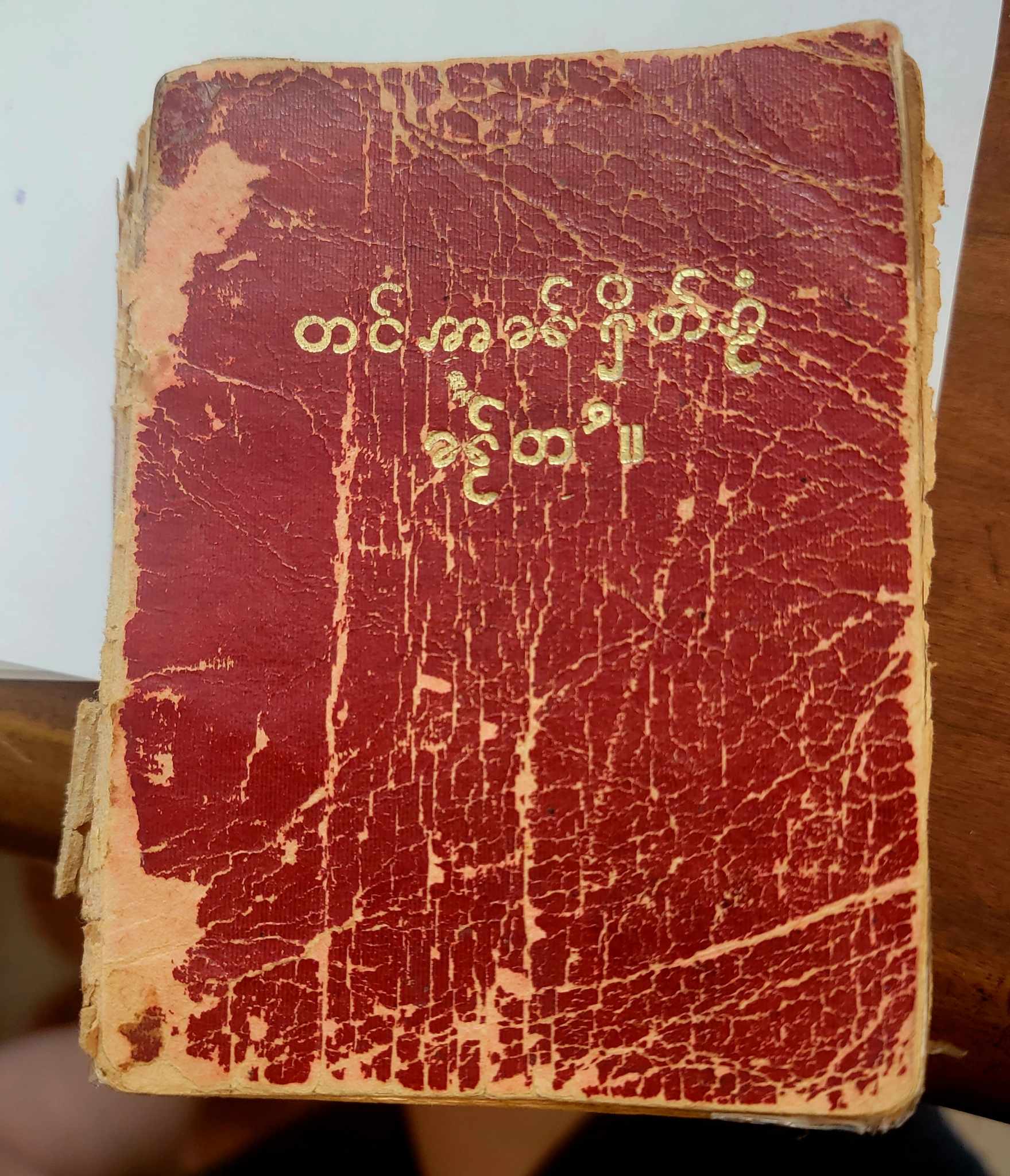
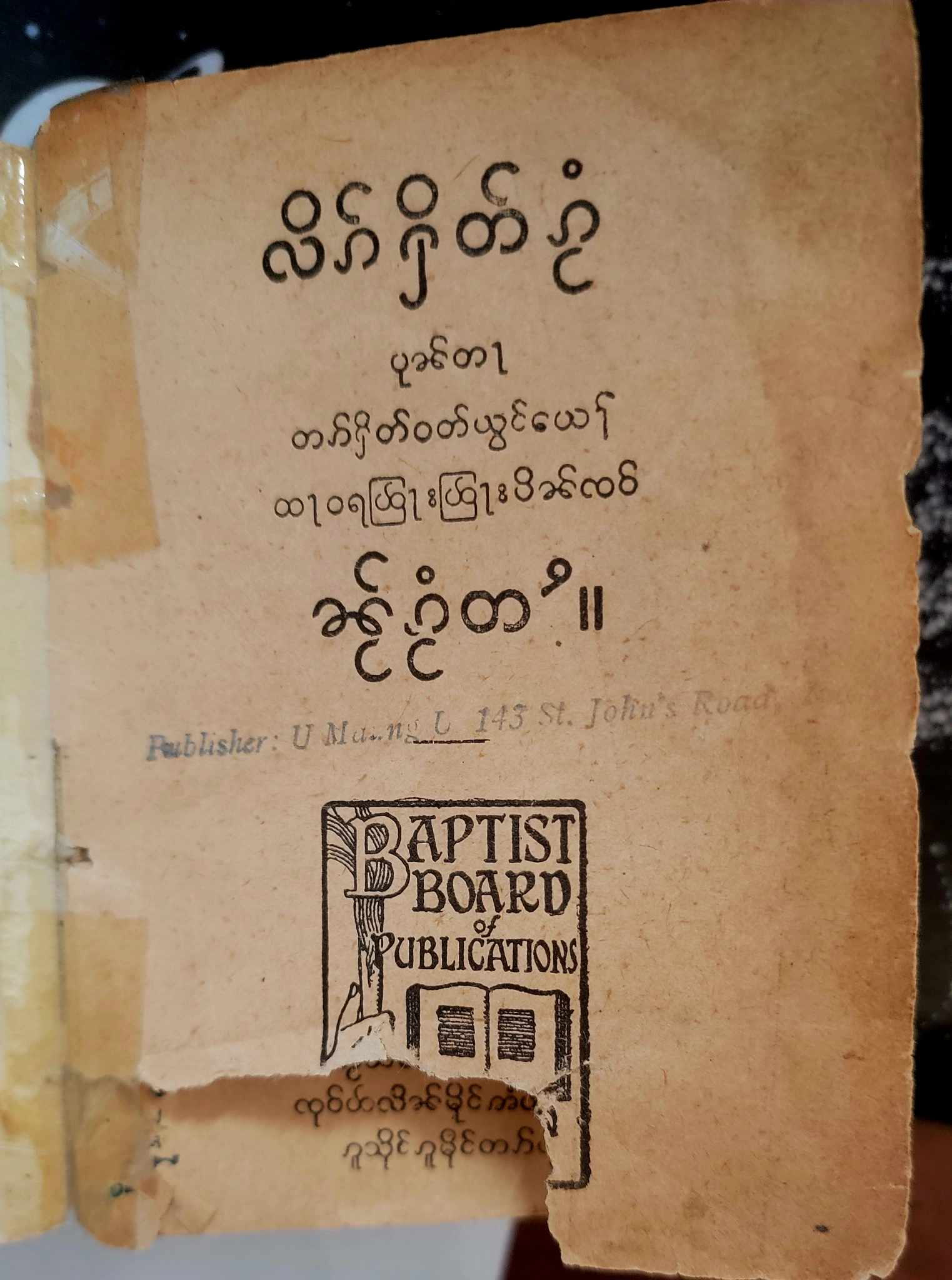
The first Shan Hymnbook
At Toungoo he immediately began a revision of Shan Gospels, Acts and Shan dictionary, which was completed in November 1876. In August 1878 Cushing went to Rangoon to attend to the long delayed Shan printing process. In November 1878 a small Shan hymnbook, the Gospel of Mark, most of Acts and fifty-six pages of Shan dictionary were printed.
Shan literature

In 1880, after thirteen years of language study, Cushing was able to finish Elementary Handbook of the Shan Language, 8 volumes, 121 pages and printed at the expense of the English Government. It was designed as a help to persons desiring to learn the Shan language. In 1881, a Shan and English dictionary was printed. In 1887, Shan grammar was revised, enlarged, and republished. The Shan Handbook was also revised, enlarged, and had sixty-four pages.
Teaching at Rangoon Baptist College
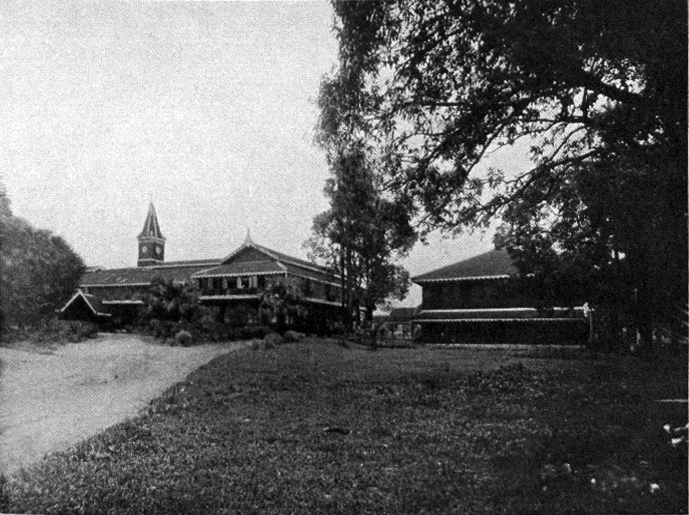
In April 1887, Rev. and Mrs. Packer returned to America, and Cushing was considered to take charge of the Rangoon Baptist College for one term. Rev. Cross and the elder agreed to assist him in instructing the higher departments, and each of them took two recitations, although one of the recitations of the latter was discontinued after a time. The term began May 16 and closed Oct. 14. More than eighty names of pupils were enrolled, but the average attendance was between sixty and seventy. There was no exhibition of racial feelings, although the pupils were made up of Karen, Burman, Shan, and Chinese. Three under teachers, a Eurasian, a Burman, and a Shan, had charge of the lower school.
Shan Believers in Mobyai and Genuine New Life
Rev. Case sent a Shan preacher to MoByai, the most southern part of the Shan States. The people of the district were pleased to see him, and the people listened well to his preaching. A Shan who gladly listened to the message when Rev. Case and team were there two years ago became a Christian and has done considerable preaching of his own accord. He was soon after baptized, remained with Rev. Case, and studied the scriptures. The three Shan preachers, this man and another helper, were instructed in the Bible for a considerable time during the rains, about five hours a week. They studied the two Epistles to Timothy and the Gospel of Mark.
In Toungoo, Mong Hswang attended the Shan services from time to time at LetKhokeBin. After a while, he acknowledged his belief in the truth of Christianity but declared that he could not be baptized because he was not ready to abandon all the heathen festivals and customs. A year later, he married the widow of Kong Warra, who was a Christian woman. Then he ceased to attend heathen festivals and walked as exemplary an outward life as a Christian, but he would not make a profession of Christianity by baptism. A year later, his wife died. This event was sanctified to him, and he determined that he would perform his duty and openly associate himself with the disciples of Christ. He asked for baptism after a long knowledge of Christian truth and with a full understanding of all that was involved in the confession to Christ before the world. He was baptized on December 19, 1886.
Cushing’s Future Plan for Shan Mission
Cushing had written a letter on January 17, 1887 suggesting the future Shan mission.
- Let all the efforts be directed to settling missionaries in Shanland at HsiPaw, MuongNai, Kengtung, and LeGya, or some places near it. Possibly NyounGyuay or MoByai would be better but that could be determined later. The home of the Shan Mission should be Shanland.
- Just as soon as it becomes possible to occupy ShanLand, let Shan-work in lower Burma as a department of Shan labor ceased. The abandonment of direct Shan-work in lower Burma must not be hasty and abrupt, but hereafter everything has reference to the occupation Shanland at the earliest opportunity.
According to Cushing’s advice the Shan-work in Toungoo was faded out and the staffs for Shan-work were slowly transferred to other new stations in Shan country.